
In situ Porosity
Three types of porosity are common in both carbonates and sandstones: interparticle primary and secondary mesoporosity, intraparticle mesoporosity, and microporosity. Primary interparticle pores are typically larger and better connected than the other pores, which results in higher total porosity and permeability. In Western sandstones interparticle secondary and intraparticle mesoporosity has formed by partial to complete dissolution of potassium feldspar and/or lithic grains. In the Frontier and Mesaverde, microporosity is common between illite, mixed-layer illite-smectite, and kaolinite clay grains. In the Council Grove it occurs within mudstone matrix.
Mesaverde and Frontier porosities summarized here range from 0.6% to 19.7%
and average 8.8%. These are within the range reported previously (Dutton
et al., 1993). Council Grove
porosities range from 0% to 28% and average 7.9%.
Most routine core analysis porosity data are measured using a Boyle's Law
type approach under no confining stress to avoid extensive equilibration
times. To obtain a porosity value as near to reservoir conditions as possible,
it is necessary to restore the core to in situ stress conditions.
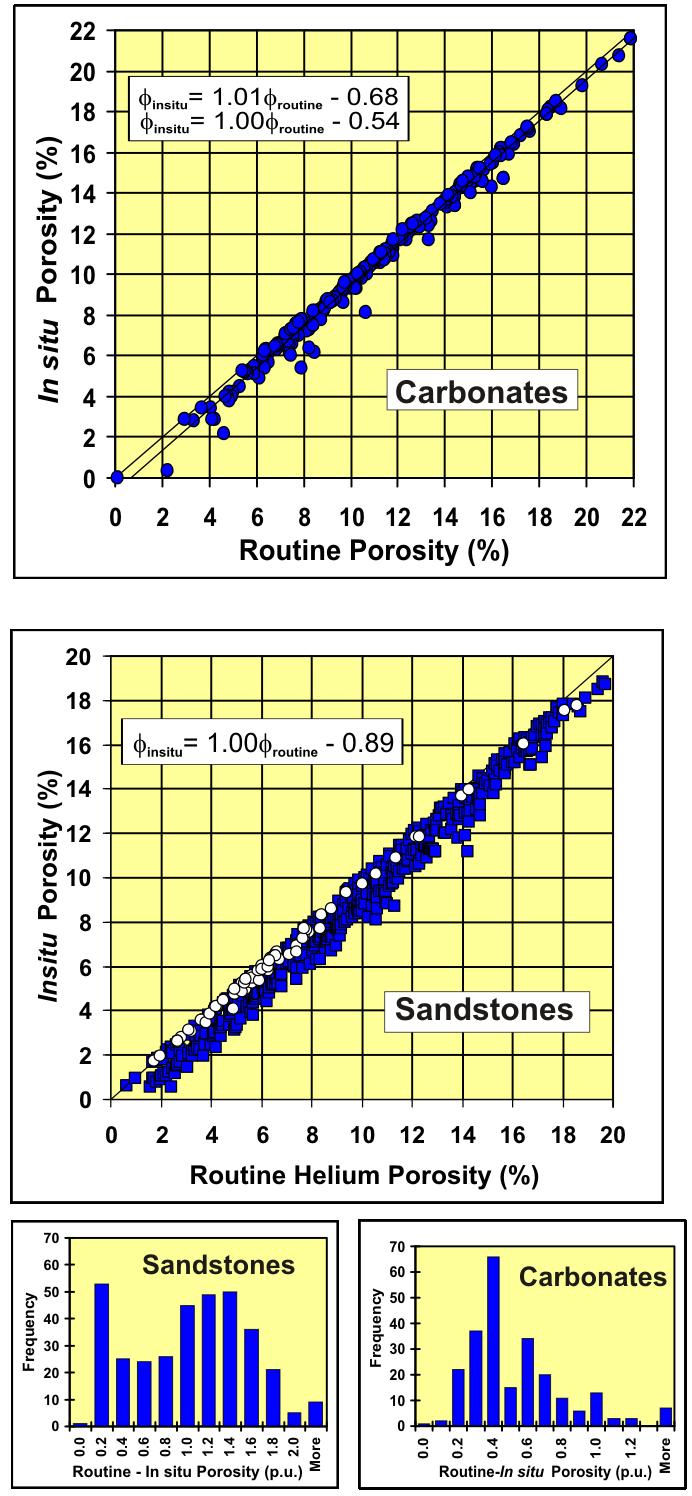
In situ porosity ( i)
and routine porosities correlate as:
i)
and routine porosities correlate as:
i = 0.997He
- 0.8 Mesaverde & Frontier
i = 1.00fHe
- 0.68 Council Grove
Where porosity is expressed as percent. The greater compressibility is believed to be primarily the result of greater ductile grain content and shaliness. Comparison with more quartzose eastern U.S. Medina low-k Ss (white squares, Byrnes and Castle, 2000) indicates cleaner low-k sandstones have lower compressibility similar to carbonates. Higher relative compressibility in low-porosity samples may indicate increasing sheet-like pore structure subject to stress.
Once cores are at in situ confining stress levels, both carbonates and sandstones exhibit low pore volume compressibility values between 1*10-6 and 7*10-6/psi. This low compressibility is typical of many low-permeability sandstones (e.g., Jones and Owens, 1980; Luffel et al., 1991; Byrnes, 1997; Byrnes and Castle, 2000) and is consistent with the high degree of consolidation.
Wireline Log-Porosity
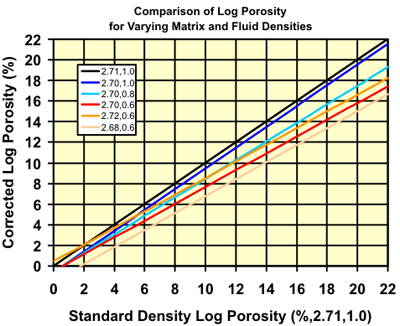
Wireline porosity logs run in low-permeability sandstones generally include one or more of the traditional porosity tools; density, neutron, and sonic. Conventionally, for density logs fluid density is assigned a value of 1.0 to represent water in the formation or flushed zone. However, in low-permeability sandstones complete flushing of the near-wellbore formation is not necessarily achieved and can be indicated by density-neutron cross-over with correction for shale influence. Fluid densities can generally be calculated based on estimated or calculated water saturation and the gas density at formation pressure. In the Council Grove low-reservoir pressures can allow filtrate invasion through the density-log depth of investigation despite low permeability.
     |
Last updated June 2004
http://www.kgs.ku.edu/PRS/publication/2001-33/P2-02.html