
Routine and In situ Permeability
In most low-permeability sandstones, in situ high-pressure gas or liquid permeability values range from a factor of 10 to 1,000 times less than routine air permeability values. This difference is primarily due to the combined effects of gas slippage (Klinkenberg correction), confining stress, partial brine saturation and the associated relative permeability, polar fluid-rock interaction, and fines plugging. Numerous investigators have shown that confining stress results in a progressively greater decrease in permeability from routine air permeability values with decreasing routine permeability and with increasing confining stress. This effect is attributed primarily to the decrease in size of the thin, tabular pore throats that interconnect the larger pore bodies.
In the Mesaverde and Frontier, routine air permeabilities range from 0.00025 md to 425 md. For the sample population measured, permeability exceeds 0.1 md in approximately 37% of all samples and exceeds 1 md in approximately 14% of all samples. Highest porosity and permeability are measured in crossbedded, medium-grained sandstones and decreases at any given porosity with decreasing grain size. Permeability is also highly dependent on shaliness, shale/clay drape architecture and decreases with increasing shaliness.
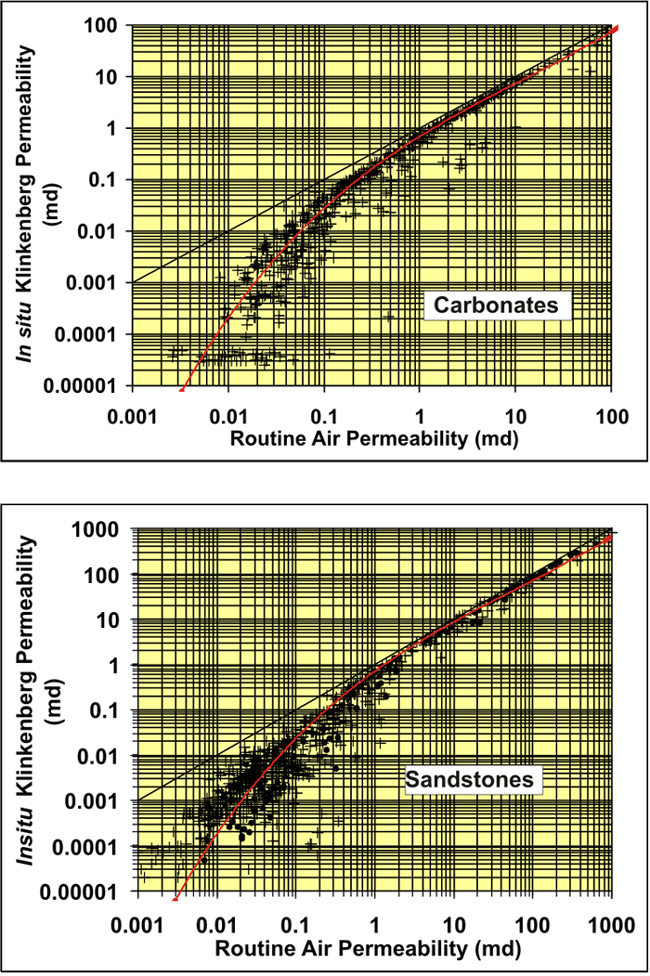
In both groups, in situ Klinkenberg permeability (ki) exhibits similar increasing difference from routine air permeability (kair) with decreasing permeability. The relationship between ki and kair for both carbonates and sandstones can be described by the same equation:
logki = 0.0588 logkair3 - 0.187 logkair2 + 1.154 logkair- 0.159
For kair<1 md, the simple linear relation describes both
rocks: logki = 1.5 logkair 0.3.
     |
Last updated June 2004
http://www.kgs.ku.edu/PRS/publication/2001-33/P2-03.html