
Porosity and Permeability - Council Grove Group
Panoma Field, Southwest Kansas
Permeability and Porosity
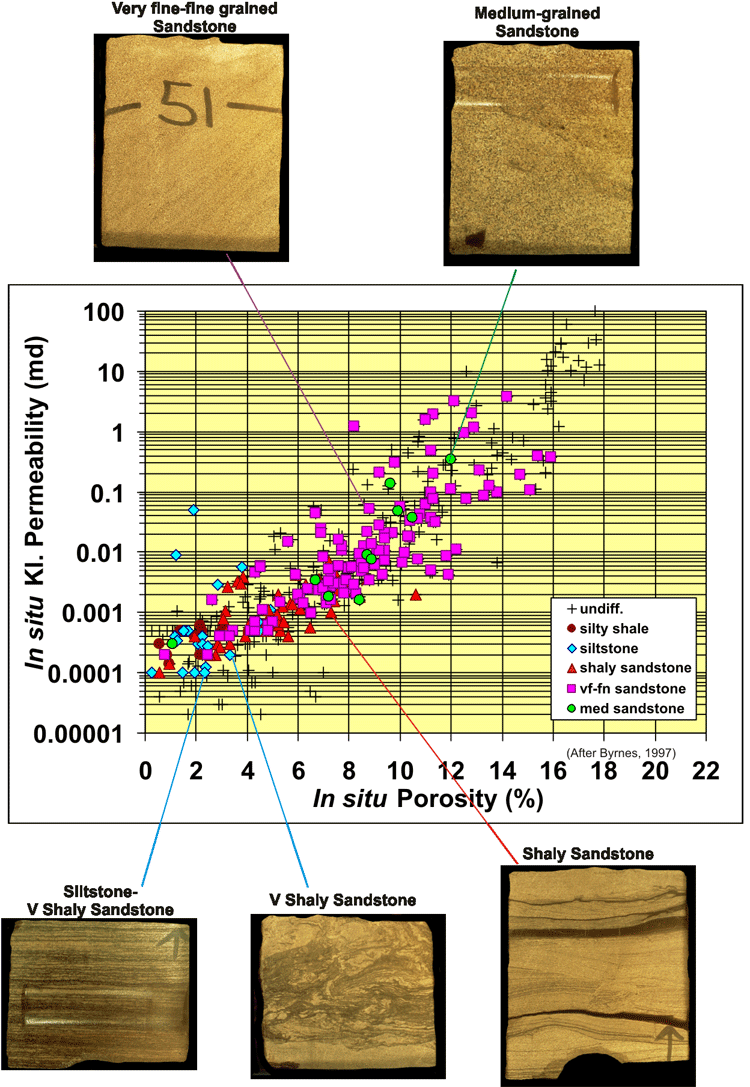
Permeability is a function of several variables including pore throat size, porosity, grain size, and shale bedding architecture. Both low-permeability sandstones and carbonates exhibit near log-linear relationships between permeability and porosity.
The Council Grove low-k carbonates and Frontier and Mesaverde low-k sandstones
can be divided into unique k- regions on the basis of lithofacies and for carbonates Dunham classification.
Similarities between low-k carbonates and sandstones petrophysical properties
regions on the basis of lithofacies and for carbonates Dunham classification.
Similarities between low-k carbonates and sandstones petrophysical properties
include:
-
An inflection in the k-
trend at approximately 8% porosity
-
At any given, permeability
decreases with decreasing grain size
-
Permeability decreases with increasing shaliness
-
Permeability decreases with increasing micro-architectural complexity including clay drapes, shale beds, bioturbation, etc.
-
Council Grove nonmarine silciclastics exhibit similar trends to Western sandstones
For any given porosity, Council Grove carbonates exhibit higher permeability than Frontier and Mesaverde sandstones. Lower permeabilities in the Western sandstones can be attributed primarily to the influence of shale laminae, more complex micro-architecture in the sandstones, and pore lining and bridging clays.
Greater permeability variance in the carbonates at any given porosity may be attributed to greater pore size heterogeneity resulting from complex grain packing and cementation.
Frontier and Mesaverde lithofacies tend to exhibit a more narrow range
of porosity for each lithofacies compared to the range exhibited by lithofacies
in the Council Grove. Permeability in the phylloid algal bafflestones is
controlled by fracturing and vuggy porosity development.
In the mudstones to grainstones, permeability is more strongly controlled
by matrix properties. Dolomitization improves permeability by a factor of
2, though partial dolomitization does not have significant influence.
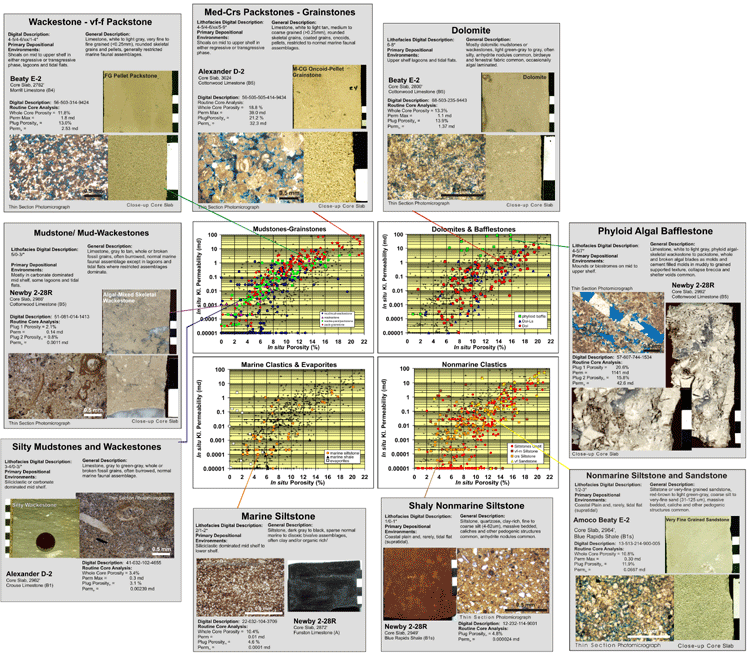
Click on each type of rock to see greater detail
     |
Last updated June 2004
http://www.kgs.ku.edu/PRS/publication/2001-33/P2-01.html