
Effective and Relative Permeability
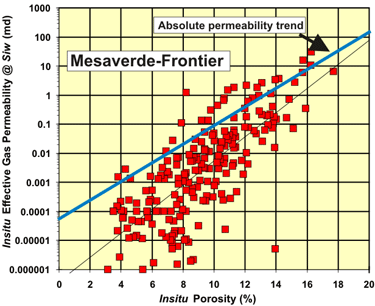
Most low-permeability gas reservoirs are at “irreducible” water saturation and remain at that saturation during reservoir depletion because of low water relative permeability. Therefore, it is useful to characterize the gas flow properties of these rocks by determining effective gaspermeability at “irreducible” water saturation (keg,Siw). In high-permeability rocks, the value of keg,Siw commonly approximates the value of absolute permeability (ki). However, in low-permeability rocks, keg,Siw can be significantly less than ki because water occupies critical pore-throat space even at “irreducible” water saturation. For this reason, keg,Siw is more important than ki as a control on gas production from low-permeability rocks. In Mesaverde-Frontier sandstones keg,Siw can be predicted from
 i:
i:
logkeg,Siw = 0.415 i
- 6.41
where keg,Siw and i
are in md and % respectively.
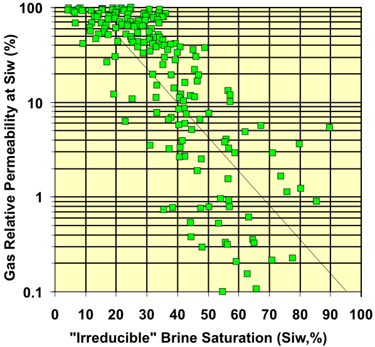
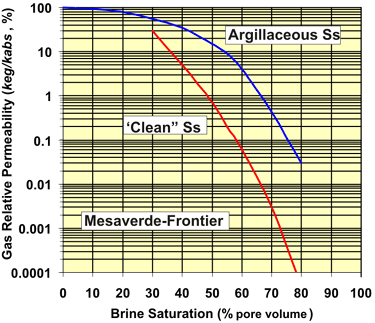
Typical gas relative-permeability curves for low- permeability sandstones show that gas permeability decreases sharply at saturations above approximately 40-50%. Expressed as relative permeability (i.e., relative to insitu Klinkenberg absolute gas permeability), Mesaverde-Frontier sandstones exhibit a sharp decrease in gas relative permeability (krg,Siw) with increasing Siw. The krg,Siw values are generally less than 5% at Siw greater than 60% following the general relation:
logkrg,Siw = -0.035 Siw + 2.4
where krg,Siw and Siw are expressed in percent. It is important to note that even at low krg,Siw and high Siw, these sandstones produce water-free gas.
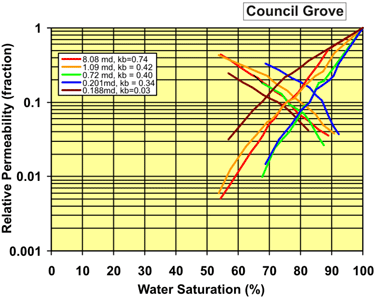
Work is still in progress on Keg,Siw for Council Grove rocks. Relative permeability curves for a limited number of cores indicate that gas relative permeabilities are also low in Council Grove carbonates at high water saturations. Note the reference k for the low-k sample is 3% of the absolute permeability.
 |
 |
 |
 |
     |
Last updated June 2004
http://www.kgs.ku.edu/PRS/publication/2001-33/P3-05.html