
Why are Low Permeability Rocks
Sooooo Sensitive to Stress?
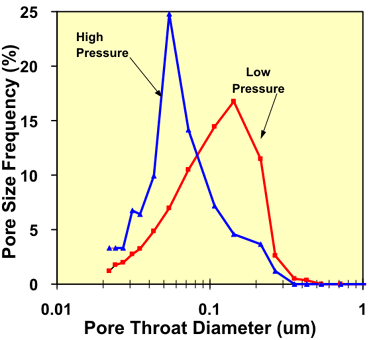
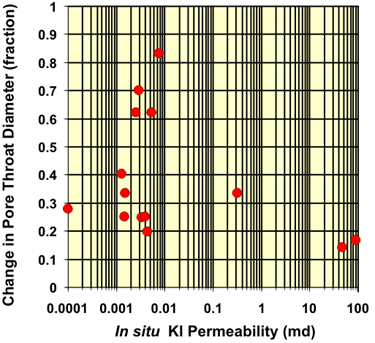
Comparison between unconfined and confined pore throats, as determined from mercury-intrusion analysis (Byrnes and Keighin, 1993), shows that under confining stress, pore throats of lower permeability sandstones decrease by as much as 30-70% (e.g., 1 um to 0.7 or 0.3 um). Using a simple model of interconnected orthogonal planar cracks, permeability can be expressed as:
K = w3L/12
where K= permeability (md), w = crack width (um), L = crack length per unit area. (note: Ostensen (1983) provided a robust model relating crack asperity to permeability).
For this model, small changes in crack width due to confining stress result in large changes in permeability. Assuming a decrease in crack width of 30% to 70%, as indicated by the mercury porosimetry, a change in permeability of approximately 3 to 40 times would be anticipated and is observed.
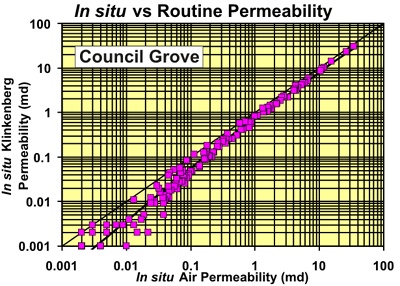
The Klinkenberg gas slippage effect also increases with decreasing pore size. Thus in situ high-pressure gas permeabilities are progressively less with decreasing pore size and decreasing permeability due to gas-slippage effects. Comparison of in situ air and in situ Klinkenberg permeabilities for Council Grove core illustrate this effect.
Finally, the influence of the same thickness of connate water will be relatively greater on smaller pore throat walls than large pore throats.
 |
|
 |
 |
     |
Last updated June 2004
http://www.kgs.ku.edu/PRS/publication/2001-33/P3-03.html