


Prev Page--Discharge of Subsurface Water || Next Page--Chemical Character of Water
Availability of Large Ground-water Supplies
Wells developed in the alluvium of Cottonwood River valley generally yield the largest amounts of water of any in the county. Wells properly constructed and located to penetrate the maximum thickness of saturated alluvial material should supply 75 to 150 gallons a minute without excessive drawdown. The capacity of wells obtaining water from alluvium in Neosho River valley below its junction with Cottonwood River is about equal to or slightly less than those in Cottonwood River valley. Alluvium in Neosho River valley above its junction with Cottonwood River is generally less permeable and thinner than below the junction and wells generally yield less than 100 gallons a minute. Supplies of 10 to 100 gallons a minute can be developed locally from alluvial terraces along the major valleys.
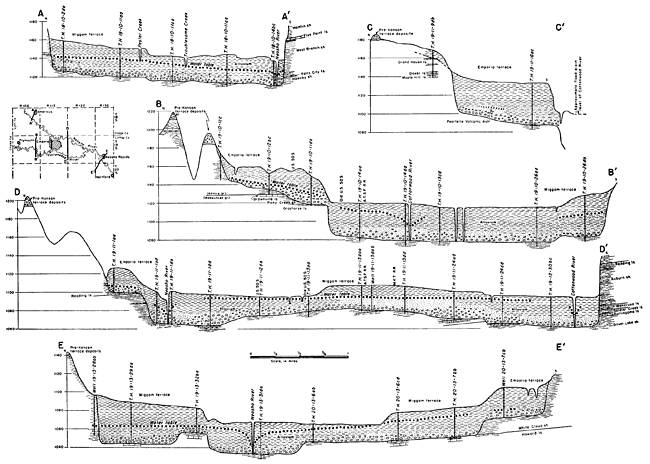
During the investigation 32 test holes were drilled with the hydraulic-rotary drilling machine owned by the State Geological Survey of Kansas on five lines in Cottonwood and Neosho River valleys. The locations of the test holes are shown on Plate 3, and graphic cross sections along the five lines are shown in Figure 3.
Figure 3--Geologic cross sections across the Cottonwood and Neosho river valleys. A larger Acrobat PDF version of this figure is available.
Wells penetrating stratified Permian or Pennsylvanian rocks generally have a much lower yield than those in Pleistocene deposits, but a few wells, chiefly in the northwestern part of the county, obtain yields of 5 to 10 gallons a minute, and in some places, 40 gallons per minute or more.
Prev Page--Discharge of Subsurface Water || Next Page--Chemical Character of Water
Kansas Geological Survey, Lyon County Geohydrology
Web version Sept. 2001. Original publication date March 1953.
Comments to webadmin@kgs.ku.edu
The URL for this page is http://www.kgs.ku.edu/General/Geology/Lyon/pt2_avail.html